Photographs have been adapted for the website; dimensions may vary.
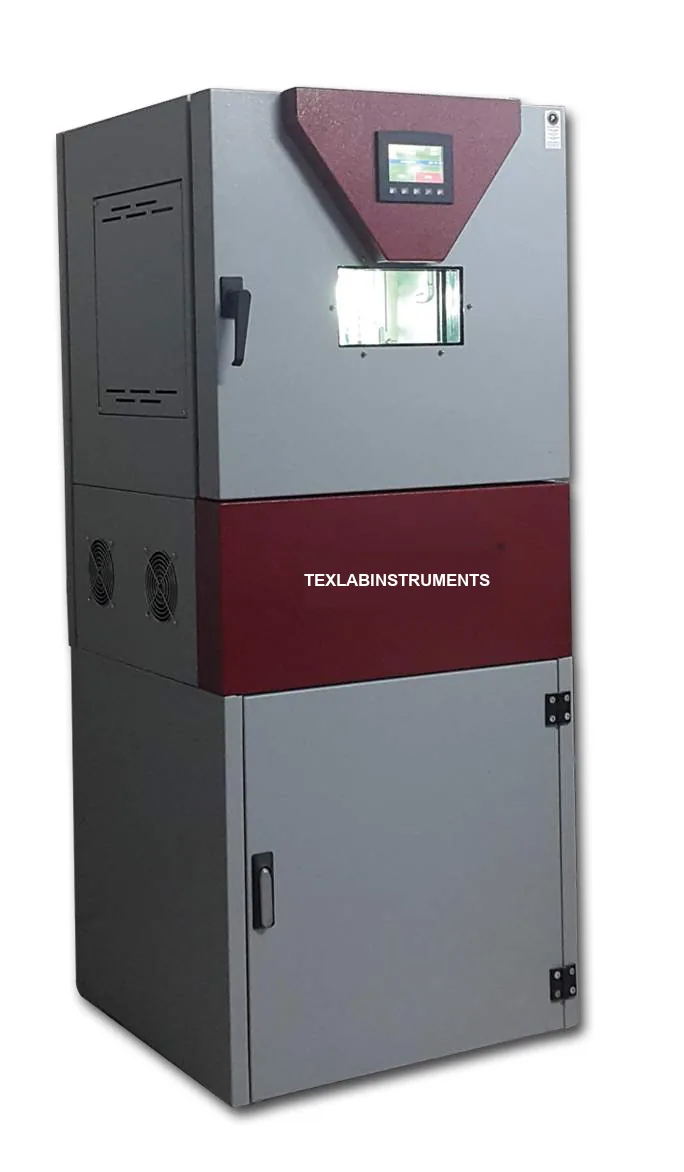
Light Fastness Tester (8 Station / 24 Specimen)
Xenon Işık Haslığı Test Cihazı (8 İstasyon / 24 Numune)
Determines the colour fastness of all kinds of textile materials, plastics, paper and similar products under artificial daylight. It is also used for white or optically brightened products. The specimen is exposed together with prepared blue wool and fastness is assessed against the reference wool. Test methods are selected on screen. The 8-station chamber holds 24 specimens.
Model technical data
- Light source: xenon arc, artificial light representing natural daylight.
- Determines the colour fastness of all kinds of textile materials, plastics and paper under artificial daylight.
- It is also used to test white or optically brightened products.
- 8-station chamber with 24 specimen holders.
- The specimen is exposed to artificial light together with prepared blue wool.
- Test methods are shown on screen and new standards can be entered.
- USB computer communication port as standard.
- Computer, printer and application program are available as options.
- Also used for weathering resistance testing in addition to colour fastness to light.
Physical specifications and utilities
| Electrical supply | Approx. 220–240 V AC, 50/60 Hz, single phase; build-dependent. |
|---|---|
| Power / connected load | Approx. 1000–3000 W connected load for preliminary planning. |
| Overall instrument dimensions | Approx. 800 × 700 × 1000 mm (W × D × H). |
| Instrument weight | Approx. 60–120 kg net. |
| Gross / shipping weight | Approx. 91–175 kg gross; estimated packing allowance. |
| Interfaces | USB computer communication port as standard. |
| Lab requirements | Suitable ventilation / process exhaust; external fan and duct loads are excluded from this preliminary estimate. |
Dimension order and approximate values are stated in each row. Packaging data are separate from instrument dimensions and net mass. Approx. rows are preliminary engineering estimates based on comparable equipment and function/capacity; they are not verified manufacturing measurements or standard requirements. Installation and shipment are finalised against the approved drawing and nameplate. Estimate scope: base product / one unit; external computer, bench and auxiliary plant excluded.
Specifications, dimensions, and power requirements are approximate and subject to change without prior notice for continuous design improvements.
Product technical specifications and images may vary according to manufacturing conditions and applicable standards.
Test and configuration
- Measured output / function
- Colour fastness after xenon exposure
- Parameters selected for the method
- Filters, irradiance, panel temperature, humidity and blue wool
- Verification points
- Irradiance, temperature, humidity and blue-wool reference
Listed methods are application references. Suitability is established by assessing the selected hardware, current method and calibration together.
Test parameters for the reviewed method
Values belong to the stated source edition. Test recipe, fixture and delivered instrument configuration are selected together.
ASTM G155-04a · 6.3, 6.6.1.1
- For xenon exposure periodically calibrate time, temperature, humidity and irradiance channels. Spray-water requirement: conductivity below 5 µS/cm and solids below 1 ppm; report pH. Select exposure cycle with the material specification.
ISO 105-B07:2009 / TS EN ISO 105-B07:2010 · 7.2-7.3
- For light fastness of perspiration-wetted textiles, soak specimens for 30 ± 2 min; target wet pickup 100 ±5%. Link perspiration solution, wet pickup, light exposure and colour assessment in the record.
AATCC 16-2004 · 1, 3.4, 12
- Record the light source and test option of the 2004 edition. Black standard and black panel thermometers do not measure the same temperature and are not interchangeable; link the selected sensor and reference-fabric operational check to the report.
AATCC 169-2009 · 6.1, 7.2
- Unless otherwise specified, this edition selects 0.35 ±0.01 W/(m²·nm) at 340 nm or 40 ±1.5 W/m² over 300–400 nm. Keep bands and units distinct; record cycle, humidity, chamber and black panel/standard temperatures separately.
ISO 105-B02:2014 · 5.2.1
- Xenon light fastness: 42 ± 2 W/m² over 300–400 nm or 1.10 ± 0.02 W/(m²·nm) at 420 nm. Black-panel and black-standard settings are not interchangeable; record selected humidity condition and blue-wool reference with the recipe.
ISO 105-B04:1994 / TS EN 2000 · 4.3
- Artificial-weathering fastness cycle: 1 min spray and 29 min drying. During the dry phase, chamber at most 40 °C; black panel at most 20 °C above chamber. Protect blue wools from direct spray; use deionized water.
M&S C9 — October 2004 · Apparatus/specimen; exposure/report; Appendix I(a–g), II and example; pp.1–11
- M&S C9 October 2004: fabric specimen at least 45 × 20 mm; British Blue Wool pieces 45 × 15 mm. Requires suitable masks and white card without optical brightener. The endpoint is grey-scale 4 change of the selected Blue Wool reference; a fixed time/dose programme alone does not provide the same assessment.
- Appendix I verifies 40% specimen effective humidity using red humidity-control fabric; this is not a 40% chamber-RH setpoint. Distinguish black-panel readings of 40–45 °C from black-standard readings of 45–50 °C. Measure with all holders fitted. These conditions are not measured instrument tolerances.
- Appendix II Ci3000+ setup: 42 W/m² over 300–400 nm, black panel 45 °C, CIRA inner/Soda Lime outer filter. Example values of 45% RH and 30 °C chamber temperature are not universal settings. Select Appendix I rotation/light-dark operation separately from Appendix II continuous light; these settings do not establish verified Texlab hardware or current M&S approval.
M&S C9A — 10.12.2009 · Apparatus/preparation; assessment1–6; report; Appendices I–III; pp.1–11
- M&S C9A 10.12.2009: specimen at least 45 × 20 mm; wet pickup 200–250% of dry mass, checked by weighing to ±0.01 g. Completely enclose in 25 µm BHT-free low-density polythene, with one layer on the exposed face. Blue Wool 1 and 2 remain dry and are not covered in film.
- Remove the specimen at grey-scale 4 change of Blue Wool 1 and dry at room temperature in subdued light. A specimen that dries during exposure gives a void result and requires a fresh test. Grade downward to a half-grade and record machine model, solution and tone change separately. Wet pickup is not chamber humidity.
- C9A Appendices I–III use specific instrument/filter/sensor setups. Do not copy Ci3000+ band-integrated irradiance into another instrument’s 420 nm sensor recipe; verify bandwidth, units, filter and black-panel/black-standard sensor. Adjust effective humidity using red control fabric. This 2009 copy is not current M&S approval or proof of supplied hardware suitability.
Control and recording specification
The following are method-specific software/recording requirements; delivered software modules are defined by the order scope.
- Method code and edition, specimen ID, operator and selected test parameters are linked to the record.
- Irradiance, temperature and moisture stages are time-aligned; spectral band and integration interval are stated when calculating dose.
- Raw measurements, units, valid/invalid test flags and the reported result remain traceable.
- Calculations are checked against known inputs and an independent calculation; sensor channels are checked against calibration values.
- The C9/C9A record holds edition, instrument/appendix choice, filter/sensor identity, humidity-control fabric result and operator Blue Wool/grey-scale assessment. C9A adds dry/wet masses, 200–250% pickup, film and invalidation due to drying. Different irradiance bands and BPT/BST sensors are not made equivalent by unit conversion.
Historical method references (current method and fixture require separate review): NF G07-012-2
Download the technical brochure (PDF)Revision: 27 October 2026Test standards
Prices start from €18. Request the technical specification and a quotation for this instrument.
Request a quoteCall usPDF catalogue