Photographs have been adapted for the website; dimensions may vary.
Oxygen Bomb Calorimeter (Building Materials, Coal and Coke)
Oksijen Bombalı Kalorimetre (Yapı Malzemeleri, Kömür ve Kok)
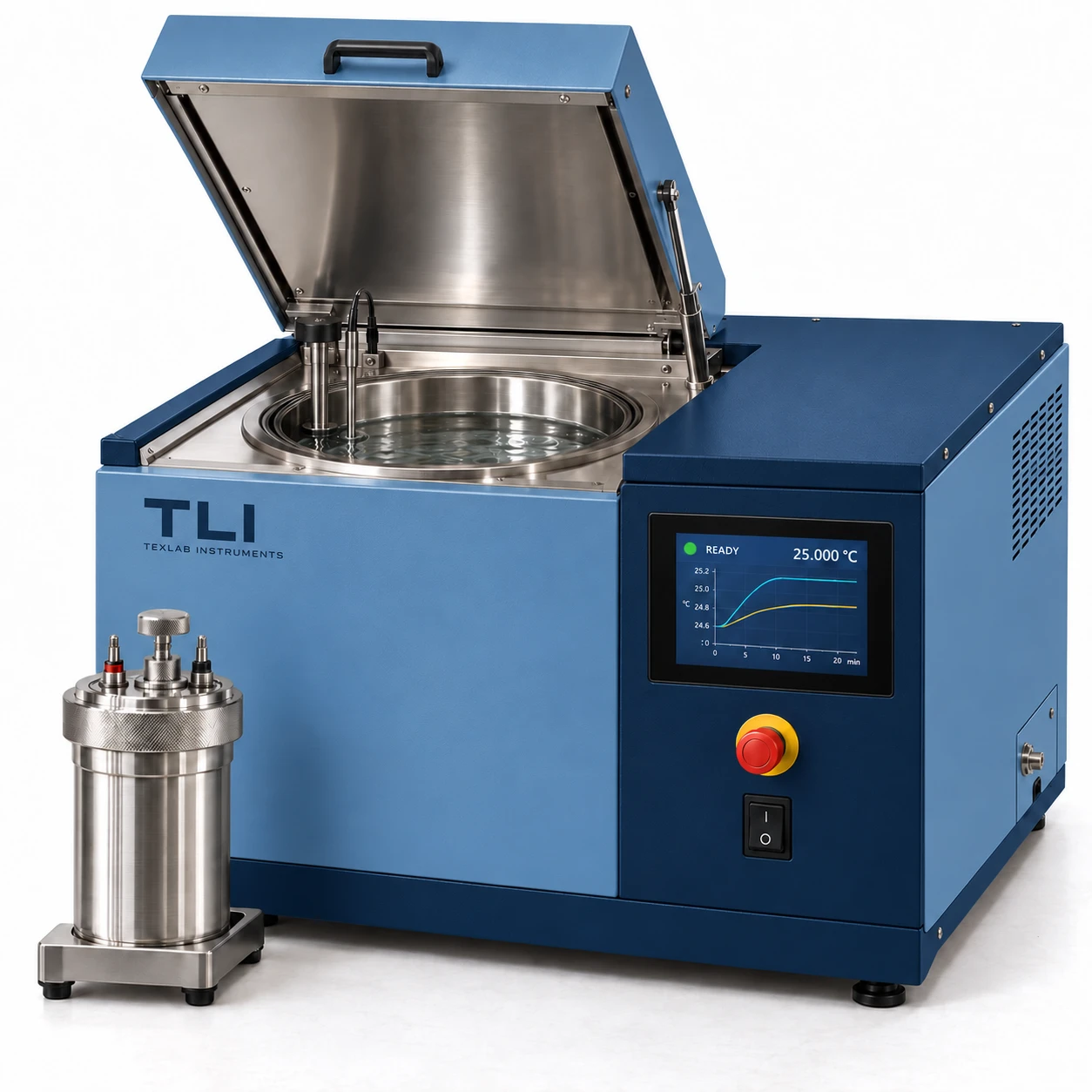
Measures the gross heat of combustion (PCS) of building materials to EN ISO 1716:2018 and the gross calorific value (GCV) of coal and coke to ISO 1928, ASTM D5865 and IS 1350 (Part 2), by constant-volume oxygen bomb calorimetry. An isoperibol water jacket, a 7-inch touchscreen and PC software are standard. For building materials, fiberglass membranes, binders and coatings, and for fuel quality control of coal and coke.
Model technical data
- Test methods: EN ISO 1716:2018; ISO 1928:2025; ASTM D5865/D5865M-19; IS 1350 (Part 2):2022 / ISO 1928:2020.
- Measurement system: constant-volume oxygen combustion; isoperibol water jacket.
- Reported quantities: gross heat of combustion (PCS) / gross calorific value (GCV), MJ/kg.
- Temperature measurement: separate precision measurement of bucket and jacket temperatures.
- Combustion vessel: sealed oxygen bomb with crucible and electrical ignition.
- Operator interface: 7-inch touchscreen PLC/HMI.
- Specimen handling: manual bomb loading; separate external oxygen filling station.
- Calibration basis: certified benzoic acid; configuration-specific energy equivalent.
- Method corrections: heat exchange, ignition and combustion aids; acid/sulfur corrections.
- PC software: method selection, temperature curves, evaluation and reports; included as standard. Computer hardware is optional and quoted separately.
- Main assembly: water jacket, inner bucket and peripheral stirrer; temperature probes and measurement electronics; oxygen bomb, crucible and ignition assembly; 7-inch touchscreen control and PC software.
- Accessories & services: external thermostatic bath, circulator and cooler; oxygen filling station and suitable pressure regulator; analytical balance and certified benzoic acid; sample preparation kit, combustion aids and spares.
- Net calorific value and moisture-basis conversions are calculated from the required additional analysis inputs. Low-energy samples use method-specific combustion aids and corrections.
- Other accessories and services are specified in the quotation.
Physical specifications and utilities
| Electrical supply | Approx. 220–240 V AC, 50/60 Hz, single phase; build-dependent. |
|---|---|
| Power / connected load | Approx. 200–600 W connected load for preliminary planning. |
| Overall instrument dimensions | Approx. 700 × 600 × 650 mm (W × D × H). |
| Instrument weight | Approx. 60–90 kg net. |
| Gross / shipping weight | Approx. 91–137.5 kg gross; estimated packing allowance. |
| Lab requirements | Method-specified oxygen, suitable pressure regulator, test water and safe filling area; external computer load excluded. |
Dimension order and approximate values are stated in each row. Packaging data are separate from instrument dimensions and net mass. Approx. rows are preliminary engineering estimates based on comparable equipment and function/capacity; they are not verified manufacturing measurements or standard requirements. Installation and shipment are finalised against the approved drawing and nameplate. Estimate scope: base product / one unit; external computer, bench and auxiliary plant excluded.
Specifications, dimensions, and power requirements are approximate and subject to change without prior notice for continuous design improvements.
Product technical specifications and images may vary according to manufacturing conditions and applicable standards.
Test and configuration
- Measured output / function
- Gross heat of combustion PCS / gross calorific value GCV (MJ/kg)
- Parameters selected for the method
- Sample preparation, mass, oxygen and combustion corrections
- Verification points
- Energy equivalent using certified benzoic acid
Listed methods are application references. Suitability is established by assessing the selected hardware, current method and calibration together.
Test parameters for the reviewed method
Values belong to the stated source edition. Test recipe, fixture and delivered instrument configuration are selected together.
ISO 1716:2018 / EN ISO 1716:2018 · 5.1, 5.3, 5.5–5.6; selected apparatus clauses
- 2018 apparatus: bomb volume 300 ± 50 mL, bomb mass ≤3.25 kg; these are not complete-instrument values. Lid/seal internal-pressure withstand 21 MPa is not the operating fill pressure. Temperature resolution 0.005 K; timer accuracy 1 s in 1 h; firing circuit ≤20 V.
ISO 1928:2020 — selected apparatus clauses · 6.1, 6.2.1, 6.2.4–6.2.5
- 2020 method: suitable bomb internal volume 250–350 mL, not equipment dimensions. About 10 mm air gap to thermostat; isothermal jacket control ±0.1 K or better. Temperature indication resolution 0.001 K; determine 2–3 K intervals to 0.002 K or better. Verify model performance by calibration.
ASTM D5865-10 · 6.2, 6.5, 6.6.1
- 2010 clauses: bomb hydrostatic proof test 20 MPa, not oxygen fill pressure. Jacket temperature within ±0.1 °C according to isoperibol/adiabatic method; automated calorimeter platinum-resistance/linear-thermistor measurement to 0.0001 °C with traceable calibration. Verify current edition and achieved instrument accuracy separately.
Control and recording specification
The following are method-specific software/recording requirements; delivered software modules are defined by the order scope.
- Method code and edition, specimen ID, operator and selected test parameters are linked to the record.
- Energy equivalent, temperature rise, specimen mass and method corrections are recorded separately; PCS / GCV is reported in MJ/kg.
- Raw measurements, units, valid/invalid test flags and the reported result remain traceable.
- Calculations are checked against known inputs and an independent calculation; sensor channels are checked against calibration values.
Test standards
Prices start from €18. Request the technical specification and a quotation for this instrument.
Request a quoteCall usPDF catalogue